




Japan’s New CX Reality: Why Standing Still Is No Longer an Option
- Home
- Insights
- Articles
- Digital Experience (DX)
- Japan’s New CX Reality: Why Standing Still Is No Longer an Option

For decades, the “service equation” in Japan was remarkably stable. It was a simple, if resource-intensive, formula: rigorous hiring practices plus exhaustive training equaled omotenashi – the gold standard of hospitality that Japanese brands are famous for. It relied on a steady stream of available talent and a consumer base that was content to wait for quality.
But today, the math behind that equation has fundamentally broken.
We are currently witnessing a slow-motion collision between two unstoppable forces in the Japanese market. On one side, a severe demographic contraction is driving labor costs to historic highs and hollowing out the workforce. On the other, a digital-first consumer population – armed with smartphones and conditioned by instant messaging – is demanding a speed of service that traditional voice-centric contact centers simply cannot deliver.
The result isn’t just a temporary squeeze on margins; it’s an existential threat to service operations. The warning signs are flashing red across the economy. Japan recorded 300 labor-shortage bankruptcies in 2024 – a staggering 60% jump from the previous year, according to reporting by News on Japan (https://newsonjapan.com/article/147706.php). These were not businesses that failed because they had poor products or bad marketing; they failed because they physically ran out of the people needed to keep the lights on.
For senior executives and CX leaders, the message is stark: the old way of scaling service – “just hire more agents” – is dead. The strategy of the last thirty years will not survive the next five.
The Labor Crisis Is Structural, Not Cyclical
If you are waiting for the hiring market to cool down so you can restaff your contact center, you will be waiting a long time. Japan’s labor shortage is not a temporary blip caused by a post-pandemic fluctuation; it is the new baseline reality of a super-aged society.
The data is unequivocal. Projections from Makana Partners (https://www.makanapartners.com/the-new-rules-of-recruitment-in-japans-tightening-labor-market) indicate a workforce deficit of 3.4 million workers by 2030, a gap that is expected to widen to a massive 11 million by 2040 if current trends hold. For contact centers, which have historically relied on a high volume of human talent to manage call queues, this is a crisis of supply. The “available” talent pool is shrinking every year, and the competition for the remaining workers is fierce across every sector, from retail to logistics to healthcare.
This shortage creates a vicious cycle inside operations. When you are chronically understaffed, your existing agents are forced to shoulder higher occupancy rates. Burnout sets in. Morale drops. Agents quit. And in this market, replacing a trained agent is not just difficult – it is becoming prohibitively expensive.
The Wage Spiral: Why Tokyo is Becoming “The New Cost Center”
When you can find talent, the price tag is significantly higher than it was even two years ago. The era of stagnant wages in Japan has ended abruptly.
Driven by aggressive union negotiations and the desperate need to attract staff, Japanese companies agreed to an average 5.1% wage hike in 2024, the steepest increase in thirty years, as reported by U.S. News & World Report (https://money.usnews.com/investing/news/articles/2025-02-04/japan-inflation-adjusted-wages-rise-in-december-on-jump-in-bonuses). Preliminary data for 2025 suggests this trend is accelerating, with increases tracking even higher.
For service organizations, this hits the P&L directly. In Tokyo, hourly wages for front-line service roles have climbed to approximately ¥2,107 (https://housingjapan.com/blog/average-salary-in-japan-and-tokyo/). To put that in perspective, this makes Tokyo nearly 2.5 times more expensive than nearshore hubs like Seoul (approx. ¥870) or Manila (approx. ¥845).
In the US or UK, the executive response to such wage inflation would be immediate: offshore the work. But Japanese brands do not have that escape hatch. The cultural and linguistic nuances of the Japanese market act as a massive barrier. Japanese consumers expect “high-context” communication – an innate ability to read the air (kuuki wo yomu), use complex honorifics (keigo) correctly, and navigate subtle emotional cues.
These linguistic and cultural requirements mean that global offshoring templates rarely work without significant friction and loss of trust. You cannot simply lift and shift a Tokyo contact center to a lower-cost geography without risking the very omotenashi that defines your brand. This traps organizations in a high-cost, low-supply environment where the only viable way to reduce costs is to radically improve productivity.
The “Five-Minute” Digital Imperative
While the operational side of the business is being squeezed by costs, the customer side is being transformed by technology. The patience of the Japanese consumer is plummeting.
Japan has become one of the most mobile-centric markets on earth. Smartphone ownership stands at 92% among adults. More importantly, the way people use these devices has fundamentally shifted. LINE has become the operating system of daily life, with 97 million monthly active users covering nearly 80% of the entire population (https://www.statista.com/statistics/560545/number-of-monthly-active-line-app-users-japan/).
These consumers – spanning Gen Z to the “Silver Surfers” – have been conditioned by their daily digital interactions. They don’t want to look up a phone number, navigate a voice menu, and wait on hold for ten minutes. They want to shoot a message and get on with their day. And they expect that response to be nearly instantaneous.
Adobe’s 2024 Digital Trends report (https://business.adobe.com/jp/resources/reports/digital-trends.html) dropped a critical statistic that should keep CX directors awake at night: 74% of Japanese consumers now expect a response within five minutes when they message a brand online.
Five minutes.
Most legacy contact centers struggle to answer the phone that fast during peak hours, let alone resolve a complex inquiry across fragmented digital channels. When a customer messages you on LINE but your team is stuck in a voice-first workflow, you aren’t just being inefficient – you are failing the brand promise.
This digital shift is also generational. Almost half of Japanese university students report having used Generative AI tools like ChatGPT. For this emerging demographic, the idea of waiting for a human to look up a manual is archaic. They expect instant summaries, auto-translations, and immediate resolution. If your service model feels “analog,” you are effectively invisible to the future consumer.
The Legacy Trap: The Invisible Friction
So, why haven’t companies adapted yet? The answer often lies in the “tech debt” hidden in the back office.
For years, Japan’s contact centers delivered high service quality in spite of their technology, not because of it. Many large organizations are still operating on what we might call a “Frankenstein stack”: an on-premises PBX system for phones, patched to a legacy CRM that doesn’t talk to the new web chat tool, which is separate again from the LINE integration handled by the marketing team.
This fragmentation creates invisible friction that kills efficiency.
- Data doesn’t flow: A customer explains their problem to a chatbot, gets frustrated, calls the hotline, and has to repeat the entire story because the agent has no visibility into the chat log.
- Context doesn’t carry: Agents spend valuable seconds (or minutes) toggling between three or four different screens to find basic customer info.
- Higher AHT: Because the workflow is disjointed, Average Handle Time (AHT) creeps up. In a high-wage environment like Tokyo, every extra second of AHT is bleeding margin.
This is the legacy trap. You cannot meet a 5-minute digital response expectation with a 20-year-old voice infrastructure. It is like trying to run a bullet train on steam engine tracks.
The Cost of Standing Still
The economics of inaction are becoming untenable. If you continue to run a labor-heavy, voice-first operation in a market with shrinking labor and rising wages, your cost-to-serve will spiral out of control.
But the risk isn’t just financial; it’s competitive. Japanese customer loyalty is increasingly volatile. The Japanese Customer Satisfaction Index (JCSI) (https://japan.jdpower.com/en/business/press-releases/2024_Japan_Customer_Service_Index_Study) and other studies have shown that in a market where high quality is the baseline, small declines in perceived service levels can have disproportionate impacts on loyalty.
Furthermore, McKinsey’s research on Japan’s digital landscape (https://www.mckinsey.com/~/media/mckinsey/locations/asia/japan/our%20work/digital/using%20digital%20transformation%20to%20thrive%20in%20japans%20new%20normal_an%20urgent_imperative_upd201223.pdf) suggests a dangerous “middle ground.” Companies that aim for incremental improvements – tinkering with the edges rather than redesigning the core – often see performance flatline within 18 months. They invest in a chatbot here or a new tool there, but because they haven’t changed the underlying service model, they don’t reap the productivity gains needed to offset the labor crisis.
There is a direct correlation between speed and sentiment. In the modern Japanese market, speed is the new courtesy. Failing to respect a customer’s time is now viewed as a lack of omotenashi.
The Path Forward: Designing for the “Digital Decade”
The winners of Japan’s digital decade won’t be the ones who just try to hire more people. They will be the ones who redesign their service architecture entirely.
This requires a shift in mindset – from “Customer Support” to Digital Omotenashi.
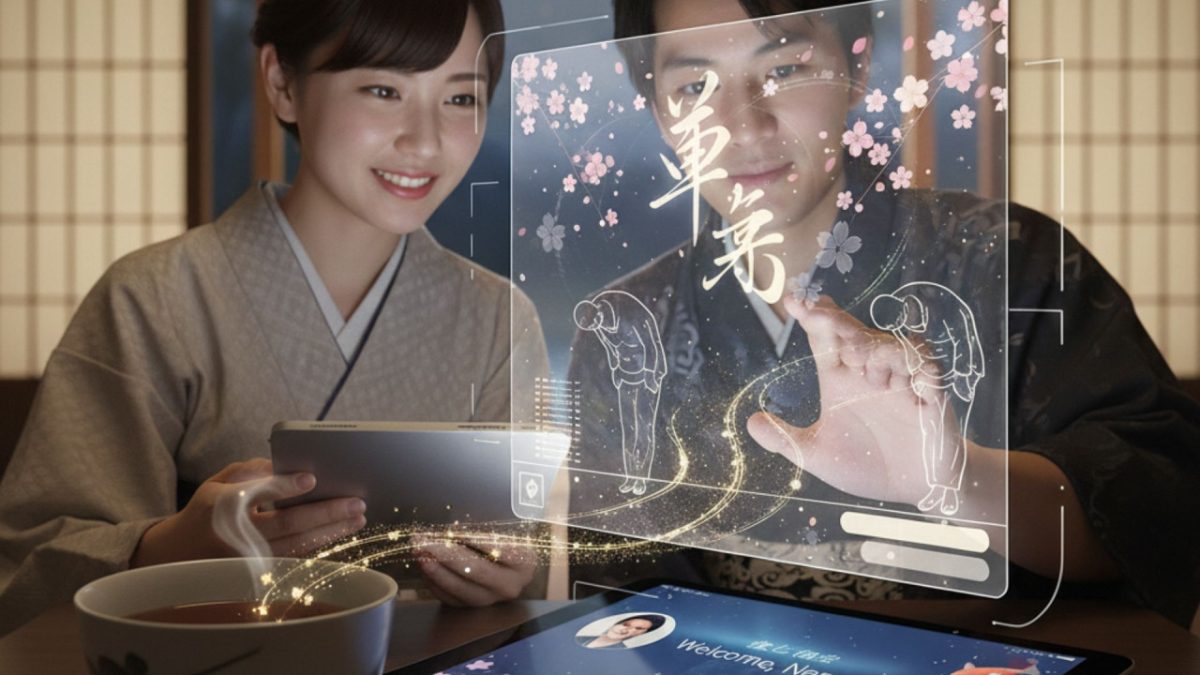
This concept, central to TMJ’s philosophy, isn’t about replacing humans with cheap automation. It is about using technology to elevate the human touch. It means building a unified digital fabric where LINE, chat, email, and voice are orchestrated as a single conversation, not separate tickets.
It involves three strategic shifts:
- From Voice-First to Digital-First (with Visual IVR) Instead of forcing every customer into a phone queue, leading organizations are deploying Visual IVR solutions. This technology guides customers from a phone dial to a digital interface on their smartphone, offering them self-service options or a chat interface instantly. This respects the customer’s preference for speed and significantly reduces the load on the voice channel – crucial when agents are scarce.
- From “Agent” to “AI-Augmented Expert” We need to stop thinking of AI as a way to replace agents and start thinking of it as a “Copilot.” In the new model, Generative AI is embedded in the agent’s desktop. It listens to the call, instantly summarizes the issue, suggests the next best response, and automates the wrap-up work. This addresses the labor crisis in two ways: it makes new agents proficient much faster (reducing the training burden), and it removes the repetitive “grunt work,” allowing humans to focus on the complex, emotional issues where they add real value. This is how you maintain omotenashi at scale.
- From Silos to a Unified Fabric To meet the 5-minute rule, data must flow freely. A unified agent desktop – a “single pane of glass” – gives the agent a complete view of the customer’s history across all channels. This eliminates the “let me put you on hold while I look that up” friction and drives First Contact Resolution (FCR) up.
Conclusion: The Time for Incrementalism is Over
Japan’s service landscape is changing faster than many organizations realize. The pressures we are seeing – the 60% rise in labor bankruptcies, the 30-year high in wage growth, the near-total dominance of mobile messaging – are not passing clouds. They are the climate.
Customers expect more, faster, and more personally than ever before. Companies can no longer rely on the traditional service equation that sustained them for decades. The math simply doesn’t work anymore.
The pressures are structural, and they require structural solutions. The companies that will lead Japan’s digital decade are those that act now to modernize their CX foundations. They will integrate digital speed with human empathy, and they will redesign their operations for a future where customer expectations continue to rise, even as the workforce continues to shrink.
Standing still is no longer an option. The transformation must begin today.
Related Insights


Expand Your Business in Japan Today!
Unlock growth opportunities in the Japanese market with our expert support. Contact us to explore how we can help you succeed.